This seminar series features Nick’s new book Focusing Change to Win which he co-authored with Kelly Nwosu.

These sessions provides business leaders with insights into critical areas to help focus their businesses and align their people for competitive advantage. Each seminar helps you answer a fundamental question:
Seminar 1: How Clear Are You On The Why & What Of Change?
Seminar 2: Why Do Your People Resist Change?
Seminar 3: Why Do You Bother to Measuring Change?
Seminar 4: How Can You Implement Change & Gain Competitive Advantage?
Seminar 5: Is Your Organization Thriving or Just Surviving?
Seminar 6: How Effectively Do You Really Communicate Change?
We take a deep-dive into a change issue that you face. You will come away with an understanding of where your expectations with key employees are aligned and not aligned, and how critical that alignment is for successful change. You will learn how to clarify and specify your own expectations as to well how you can check if they are understood. Each session helps executives assess their performance in terms of:
- How well have you communicated your expectations to your people?
- How well do you understand what your people expect of you?
- What are the likely gaps between expectations and assumptions?
- What are our options for planning and implementing success change competitively?
What do you get?
- A copy of our new book Focusing Change to Win
- A tool, the Four Blocker Alignment Analysis, to identify misalignment
- A method to help set the right expectations and get people on the same page
- An understanding of how to align agreed expectations effectively
- An example of an aligned expectation relevant to your situation
- An improved chance for successful change in your organization
What preparation is needed?
For each participant organization we have preparation guides that ask people to consider issues related to the question being posed for each seminar.
Who should you bring?
Please select up to five key people to join you who are important to successful change in your organization, such as:
- Which colleagues will help you answer the seminar question posed?
- Whose opinion do you value to help look at the question posed from different perspectives?
- Whose commitment will you need to make improvements in tackling change competitively?
What will be covered?
Each session focuses on real-life scenarios within the framework of the research findings and assessment tools developed. As we say:
“There is no role-play only real-play”
Seminar Format
Seminars are customized for clients and depending on their needs. They normally run from half-day to full-day. They can be run fact-to-face or web-based, although experience suggest face-to-face gets the best results
Maximum attendance is 20 participants! Costs start at $150 per person per half day excluding agreed preparation time, travel and accommodation.
Why are these seminars important?
Failed change means lost opportunity, competitive vulnerability, poor revenues, lost employees, increased cynicism and fear. Its residue is a hostile and toxic culture, where change resistance becomes the norm. The cost of a failed change can be staggering, from lowering morale to losing key customers due to poor quality.
Focusing to Win and the survey on which it is based confirms other studies.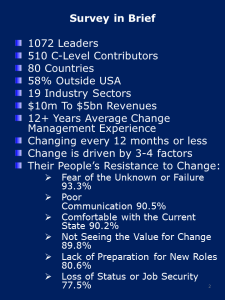
Too many organizations are still trying to do things differently not do different things
Survey Contributors realize that working relationships are increasingly stressed in the drive for ever-faster responses to competitive threats and opportunities.
So, what are the meaningful differences between those that thrive on change and those that just survive?
Many contributors seem resigned to resistance being unavoidable yet recognize that trust in management is the only variable that significantly reduces change resistance. They seem to have little focus on improving organizational alignment to achieve change success.
For others, whatever the blend of top down and bottom up led change, it is clear – be intentional. This is invaluable to avoid being misinterpreted and mistrusted. These contributors are clear and details how to lay the groundwork for successful change.
Each seminar takes an aspect of the problem based on over 6,000 comments to give participants an assessment framework for their organizations. These cover analyzing change impacts, setting-up the change Program with Metrics and on-going communication.
For a copy of the book Focusing Change to Win goto https://tsw.createspace.com/title/4507924

Seminar 1: How Clear Are You On The Why & What Of Change?
Session overview
Here’s why this seminar is important today. Organizations are changing every 12 mths or less driven by 3-4 reasons for each change. All these changes need to decide three things. What they need to:
Stop doing
Start doing
Continue doing
This seminar serves as a reminder. The enemy at the gate is not change. The real enemy is indecision, inactivity, inflexibility and change resistance. Any change will generate friction. This friction will serve you best if you use it to grow wiser and better, more competent and responsible.
It works like this, assuming we are always managing change with limited resources like people, money, technology and time leaders have to manage the tension between what they stop, start and continue doing. Then, after deciding the commercial need for change, leaders need to identify which groups and people are more likely to experience unhealthy stress and resistance.
What you will learn
In this event we help you stand back to see what different approaches you can take to grow wiser and better.
This seminar distils our findings to contributor questions for developing effective change communication. These are then used to help participants assess their change condition and start or improve their current planning framework.
Key topics
- Why people say they are changing
- How often do they change
- Ten Best Contributor Practices
- Reducing Employee Stress to Manage Change Resistance

Seminar 2: Why Do Your People Resist Change?
Session Overview
Accelerated change demands more of everyone. Accelerated change failure creates cultural toxicity. Toxicity is the result of the Fear, Uncertainty and Doubt (FUD) of past downsizing and directives to do more for less. Where people are cynical about change, pessimism sets in, and failure is assured.
Our Survey Contributors recognize change resistance is natural, but you don’t need to make it that difficult as long as you do some things profoundly well. This seminar helps leaders separate the symptoms of change resistance from the stressors that causes it.Accelerated change demands more of everyone. Accelerated change failure creates cultural toxicity. Toxicity comes from the Fear, Uncertainty and Doubt (FUD) of past downsizing and directives to do more for less. Where people are cynical about change, pessimism sets in, and failure is assured.
We find that leaders find it valuable to recognize the causes of Change Resistance and how it helps them develop more effective ways of reducing it. The top reasons (90%+) are fear of the unknown, failure, poor communication and not seeing change is any better than the status quo. Our contributors say that, if leaders create clear and consistent frameworks, you help most people make informed decision about committing to a change or not.
Here’s what they are saying:
- Clear Direction: Leaders clarify their change’s What, Why, How and WIIFMs
- Align Expectations: Between leaders and people
- Develop Accountabilities: by developing the rewards and consequences that make sure expectations of both leaders and their people are met.
Key topics
Managing Change Stress & Resistance:
- Introduce tools for participants to look at ways of reducing employee stress to better manage change resistance
- Leadership challenges and the impact leaders’ inconsistency and how it fuels people’s natural resistance to change.
- Developing more consistent communication focusing people on the Why and What of Change.
- Establishing a change accountability culture
Seminar 3: Why Do You Bother to Measuring Change
Session Overview
In this seminar we look at key ways for measuring change success based on the analysis of our global survey. Participants get help in diagnosing these disconnects in their own organizations and develop plans for developing more effective change measurement.
What You Will Learn
Disconnect 1: The apparent disconnect of the benefits of measuring a change’s impact on marketing and customers. Yet, contributor’s most common reasons for losing customers is poor quality (92.2%), follow-up (76.5 (%)) and assumptions about customers (64.5%).
Assessment 1: We help participants assess how well their planned changes are connected to creating competitive advantage.
Disconnect 2: The low use of employee metrics other than satisfaction surveys. There seems little emphasis on personal behavior change and tracking pay related rewards. This is further evidence of the poor focus on accountability and establishing a requiring environment.
Assessment 2: We help participants review their current employee metrics and ways to improve their value to the change process
Disconnect 3: Little thought they give to blend lagging and leading metrics. This reduces their ability to change course and ineffective tracking of behavioral and cultural issues.
Assessment 3: We help participants review their lagging and leading indicators and how helpful they are in implementing and executing successful change
Lastly, even when metrics are agreed, we help participants improve these metrics transparency so that they create and sustain change momentum.

Seminar 4: How Can You Implement Change & Gain Competitive Advantage?
If you compare the top three reasons contributors gave for losing customers and compare them with the change metrics used, you would think they were from two different universes. Change drives these leaders, while customers and competitive advantage are apparent afterthoughts.
For example:
- Benefits of Measuring Change Comments Related to Customers 3%
- Focus of Successful Change Comments on the Role of customers 12%
- Enabling the Thriving Organization Comments Mentioning Customers 12%
- Common Reasons for Losing Customers: Poor Quality, Poor Follow-up &
Assuming to Know Customers
Session Overview
In this seminar we look at practical ways to avoid these pitfalls. We help participants review how well they are managing change for competitive success.
What you will learn
Overall we look at change as a competitive weapon and challenge any lack of connection between change and competitive advantage by focusing on:
- Being First & Outpacing the Competition
- Developing Competitive Agility – Anytime, Anywhere, On Anything
- Implementing Change to Gain Competitive Advantage – Questionnaire & Protocols
- Focusing on Change to Gain Competitive Advantage
Key Topics
We focus on five areas to improve competitive advantage through change. They are:
1. Market & Competitive Sensing
2.Leading Competitive Change
3.Integrating Change into Operations
4. Building CompetitiveHuman Capital
5. Developing Competitive Agility
Seminar 5: Is Your Organization Thriving or Just Surviving?
Session Overview
This seminar is useful for those executives who want to stand back as ask:
- Are we really thriving or just surviving?
- What can we do to reinvigorate people?
- What are other leaders doing to get back to thriving?
- How can we emulate their approach to become a thriving company?
Objectives
We examine survey contributor comments on what enables and disables successful change. We then help participants on where they should start focusing so they can thrive’
Key topics
We do this by dividing the seminar into six parts based on Survey Contributor recommendations.
1. Leadership in Thriving Organizations
2. Change Management in Thriving Organizations
3. Planning to Thrive
4. Thriving People
5. Communicating to Thrive
6. Learning to Thrive
At the end of this seminar or workshop, this wide-ranging analysis helps participants decide where their organization is in terms of Surviving and Thriving Organization. It then helps people form plans to put the “thrive” back in their organization
Seminar 6: How Effectively Do You Really Communicate Change?
Session Overview
In this seminar we take 684 experiences contributor recommendations on communicating for successful change. Their focus is how to gain stakeholder commitment to create a force multiplier of powerful change ambassadors.
We also critique contributor “blind spots” and their tendency to focus more on technique and convenience and not deal with strategic issues when communicating change.
These low levels indicate the need to challenge change leaders on requiring authentic communication and dialogue. Contributors are clear. This only happens when communication centers on establishing trusting relationships.
Objectives
At the end of this seminar, we take participants through assessment tools and discussions for them to answer – What role does our communication play in reducing change mistrust and cynicism among employees?
Key topics
- How effective is your communication process?
- Analyzing Change Impacts
- Set-up Change Program with Metrics
- On-going Communication & Training
- Communicating the Change Requiring Environment